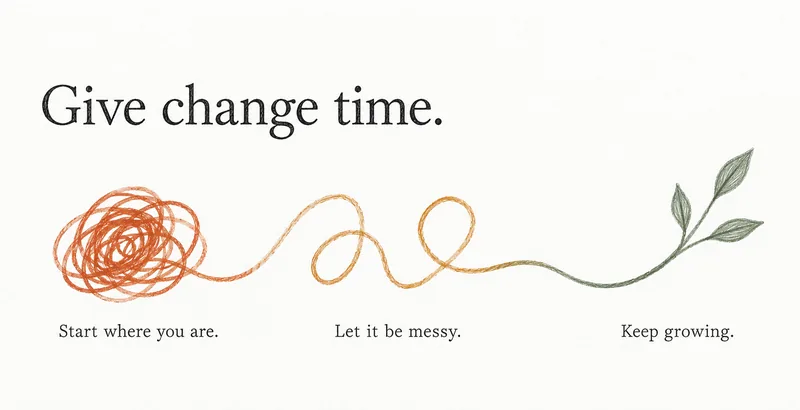
There is a poster on my wall that says four things. Give change time. Start where you are. Let it be messy. Keep growing. A friend gave it to me during a year when I was trying to become a different person all at once, and she had clearly run out of gentle ways to say slow down. For years I read the poster the way you read a slogan on a coffee cup, as decoration with good intentions. Then life got patient with me, whether I liked it or not, and I started to take the words seriously.
Give change time is the hardest line of the four, because most of us were trained to treat time as the enemy. We optimize it, save it, and resent it whenever it moves slowly. We talk about killing time and spending it and running out of it, as if it were a currency we are permanently short on. But change is the one thing that will not be hurried, and the whole skill of living, as far as I can tell, is learning to stand in the same room as things that are not finished yet, without pretending they are finished and without punishing them for not being so.
Start where you are
Impatient people do not actually want to start. They want to start somewhere else: at the finished version, at the fluent stage, at the Tuesday when everything suddenly became easy. I have postponed more things waiting for a better starting point than I have ever finished, and I suspect the same is true for most of us. The problem is that change has no skipping function. You cannot begin at the middle, no matter how much you dislike the beginning, and waiting for a cleaner version of yourself to show up is just a more comfortable way of not starting at all.
Watch out for the fresh start, which is postponement wearing a costume. The clean Monday, the first of the month, the new year: they all promise that a better version of you will be waiting on the other side of the date, and the date always arrives and the version never does. Momentum does not care about calendars. It cares about the day that is already under you, which is why starting on a random Tuesday in the middle of everything else beats waiting for a Monday that looks clean. No Monday is clean. The clean ones are the ones you never started.
Where you are is also never as bad as waiting makes it look. Everyone I have ever watched get good at something began from an embarrassing first try: the first chord, the first draft, the first shift at a job they did not understand. Nobody framed those moments and nobody posted them. They simply paid their time and moved on, which is the only honest definition of starting where you are. The floor is not a shameful place to begin. It is the only place where beginning is possible.
Let it be messy
My instinct with anything new is to make it presentable before anyone sees it, and that instinct has quietly cancelled more projects than laziness ever did. We treat mess as a failure of the process, when mess is the process. No one writes a paragraph fully formed; they write a bad one and then a better one. No one learns a language in whole sentences; they stumble through fragments first. The sprout does not emerge from a clean surface. It comes up through dirt, and the dirt is doing real work.
The tangle on that poster is not a mistake. It is the shape of every beginning that is still becoming: knotted, loopy, and completely unconcerned with how it looks. The people who finish things are simply the ones who agreed to be seen while unfinished. They let the mess stay messy long enough to grow into something, and they did not apologize for the middle. The rest of us are busy comparing our middle to everyone else's end, which is the fastest way to make any honest beginning feel like a failure.
Mess also needs to be defended from the people who love you. The well-meaning question how is it going, asked too early, can feel like an inspection. The comment that looks rough is usually true and usually unhelpful, because it mistakes the middle for the end. I have learned to tell people what stage the work is at so they do not review it like a finished thing. Call it a sketch, call it a first pass, call it dirt with a sprout in it. Naming the stage out loud protects the mess long enough for it to become something.
Keep growing
Patience is not passivity, and the poster makes the distinction on purpose. It does not say wait around. It says keep growing. Waiting is what you do when you have stopped. Growing is what you do when the result is out of your hands but the effort is not. You water, you show up, you do the unglamorous version of the work, and you let the calendar do the part that only it can do.
Growth is also almost always invisible on the day it happens. A muscle does not appear after one workout; it is built in the nights you cannot see it. A bruise heals one shade at a time. A sprout rises a few millimeters, then stops, then rises again, and only the gardener who checks every morning can tell that it is winning. Most people quit in the boring middle, not because the middle is hard but because it looks like nothing is happening. Something is happening. It is just happening below the surface, on the schedule of the thing itself rather than on yours.
I keep receipts for exactly this reason. A notebook from a year ago shows me worrying about the same thing I am worrying about now, and it also shows me that the thing moved anyway, without my permission and without my noticing. The language got better. The work got steadier. The person I was trying to become showed up in small installments, and I would have missed it entirely if I had not written down where I was standing. That is what patience looks like from the inside: boring, unverifiable, and completely real.
Patience is loudest with people
The hardest patience is the kind we owe other people, because people are the only things that can disappoint you while growing. The learner who asks the same question again, the colleague who is slower than the project needs, the friend who is taking their own time to change: none of them can be accelerated by pressure. Pressure does not speed a person up. It only teaches them to be afraid of growing in front of you.
I think about my mother learning to use her phone, and how she asks me the same question every few weeks as if it were the first time. The easy version of me sighs. The patient version of me remembers that every answer I give is also a lesson in whether it is safe to be slow with me. People grow fastest around people who do not flinch at their pace. The colleague who asks again is not failing to learn. They are testing, without knowing it, whether I am someone who teaches or someone who performs impatience.
Every person is on their own sprout clock, the way I am on mine, and the test of my patience has never really been my work. It has been the people who learn at their own speed, which is to say, everyone who is not me. With work you can walk away. With people, walking away is not usually an option, and that is exactly why patience with people is where the whole skill gets practiced for real.
So I am trying to be patient with everything now: with the work, with the people, with the version of me that is still mostly knot and hardly any sprout. Patience, I have learned, is practiced in small acts: the sentence you do not force, the person mid-thought you do not interrupt, the reply you wait an hour to send. Everything is on its own clock. The only thing I control is whether I am still there, watering, when the clock finally strikes. That poster has been on my wall for years. I used to think it was decoration. It was instructions all along.
Thanks for reading.
Save this story for later, or pass it to someone who might need the perspective.
Did this make you think?

Follows good stories wherever they hide, from construction sites to coffee counters. No specialty means nothing is off the table.