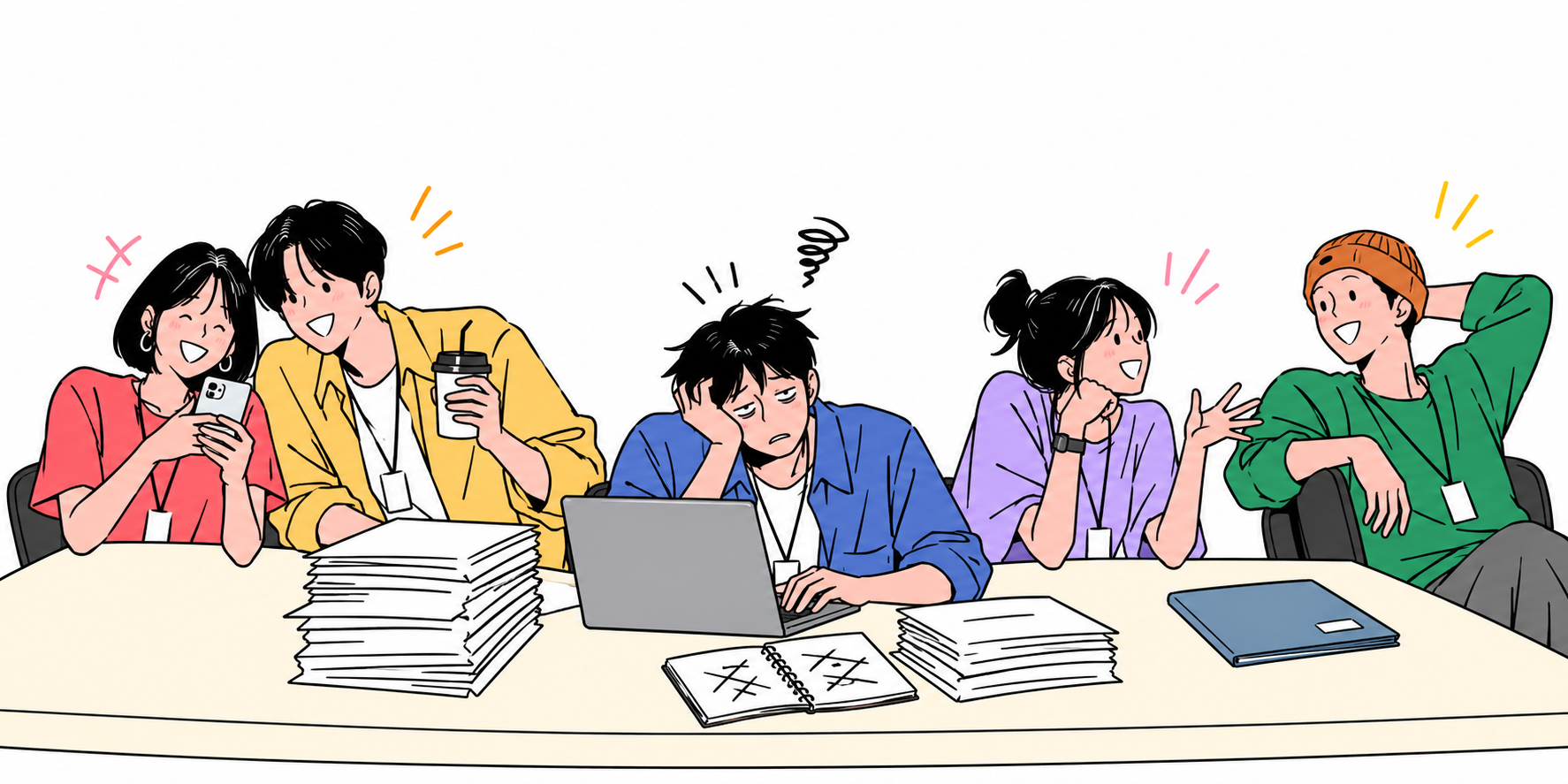
I hate working as a group. There, that is the honest opening, and it already feels more useful than most group projects I have sat through. The usual advice is that teamwork makes the dream work, but nobody ever explains what happens between the teamwork and the dream. Usually there is a meeting, a shared document, three competing opinions, and one person quietly finishing the work at 1:00 a.m., because by then the deadline has become more real than the team.
The problem is not people. People are often excellent one at a time. The problem is that a group can turn a simple task into a small government. Every decision needs a discussion, every discussion needs a follow-up, and every follow-up creates a new decision. Soon everyone is very busy explaining what should happen, and nobody has touched the thing that actually needs to happen.
I once joined a project that needed one page of writing and a handful of images. On paper, it was an afternoon of work. It took two weeks. The first meeting was for planning, which was fair enough. The second was to review the plan, which was also fair. The third was to discuss why the plan had changed after one person saw an early draft and decided the whole direction was wrong. By then the page had a title, a tone, a folder of reference images, and no sentences.
The end was almost funny. Two people who had been quiet for the entire project appeared on the final day, made three large suggestions, and left before anyone could ask who would implement them. One of them later described the result as “our page” in a message to a manager. Technically, he was present. He was present the way a person is present at a wedding they did not plan and only attended for the cake.
That project is the reason I started paying attention to group work instead of just complaining about it. Somewhere under the mess, there was a real question: why does a job that one person could do in a day become a two-week negotiation when a group touches it? The answer is not that groups are stupid. The answer is that groups are very good at producing the feeling of work, and the feeling of work is not the same as work.
The meeting before the meeting
Group work begins with the meeting before the meeting. Someone sends a message asking when everyone is free. Everyone replies with a different time. A poll is created. The poll needs its own deadline. The deadline gets moved because two people never voted. By the time the meeting finally happens, the original task has aged into a problem with feelings attached to it.
Then we sit in a rectangle and take turns discovering that the task is larger than we assumed. The person who prepared gets frustrated. The person who did not prepare says we should keep our options open. Someone uses the phrase “let us align,” and the room loses another twenty minutes to a word that means nothing and sounds like progress. I do not hate alignment. I hate pretending that talking about movement is the same as moving.
Meetings are not automatically bad. A good meeting removes uncertainty: it answers a question, assigns an action, or makes a decision that genuinely could not have been made alone. A bad meeting does the opposite. It turns uncertainty into a shared atmosphere. Everyone leaves feeling involved, nobody can say what changed, and the calendar has quietly eaten two hours that the project will never get back.
The worst meetings are the ones where everyone is afraid to be the first person to decide. We circle the obvious answer because choosing it would make one person accountable for the outcome. We call this being thoughtful. Sometimes it is. More often it is fear wearing a lanyard. A decision does not become wiser just because twelve people watched it happen.
A group can turn one clear question into twelve people waiting for permission to answer it.
The invisible work
There is always invisible work in a group, and it is usually done by the person who cares most about the result. They write the agenda, chase the missing files, stitch everyone’s half-sentences together, remember what was agreed, and send the message that says “just checking in” when what they mean is “please do the part you promised three days ago.” Nobody assigns this work, because assigning it would mean admitting that it exists.
The group then calls the finished result a team effort. Technically, this is true. A team was present. But presence is not contribution, and contribution is not the same as attaching your name to the document at the end. I have watched people arrive for the last ten percent and speak as if they had carried the first ninety. Group projects are unusually generous to the person who walks into the room just before the photograph.
There is also invisible emotional work. Someone notices that two people are annoyed with each other and changes the subject. Someone softens the feedback so it can be heard instead of defended. Someone remembers to ask the quiet person what they think, then waits long enough for a real answer instead of a polite one. This work matters, and it has a strange career path: when it succeeds, everyone assumes the room was naturally healthy, and when it fails, the same person is asked to fix the mood again.
I am suspicious of any system that depends on one unusually responsible person to stay alive. That person looks like a hero from the outside, but mostly they are a warning. If a project collapses the moment they take a day off, then it was never a team. It was one person with witnesses.
The cast of every group project
After enough of these, you start to recognize the roles, the way you recognize the characters in a show you have watched too many times. There is the Ghost, who joins the group, says something enthusiastic in the first meeting, and is never seen again until the deadline, when they reappear to ask how it is going. There is the Meeting Lover, who believes every problem is a scheduling opportunity and would happily hold a meeting to plan a meeting. There is the Idea Fountain, who produces brilliant concepts at a rate that would be impressive if any of them had to be executed. There is the Silent Worker, who says almost nothing, does a third of the project, and gets mentioned last. And there is the Manager, who has no special skill except the confidence to tell everyone else what their skill should be.
I have played most of these roles myself, and I will get to the uncomfortable version of that later. The useful thing about naming them is that it turns a vague frustration into something you can actually manage. You cannot fix “the group.” You can notice that the Ghost has not replied in five days, and you can decide, calmly and early, that their part now belongs to someone else.
The group chat is not the work
Remote work made all of this easier to see. In an office, at least you can tell when someone is not working, because they are standing near the coffee machine with the particular posture of a person avoiding their inbox. In a group chat, activity looks like progress. A stream of messages appears: thumbs-up, good point, quick question, small correction, new question caused by the small correction. The project feels alive because the notifications are alive.
I have lost entire mornings to messages that contained no decision and quietly created four new threads. Someone asks whether we should use the old file or the new file. Someone else says they prefer the old file but is open to the new file. A third person asks which one is the old file. By lunch, the group has reached a firm consensus that files are complicated.
The cure is not silence. The cure is turning conversation into an artifact. If a decision is made in the chat, write the decision somewhere visible. If an action is promised, attach a name and a date to it. If the group cannot state what it is deciding, stop typing and write the question down first. A chat is very good at proving that people were present. It is not good at remembering what they agreed to.
The office, the classroom, and the group chat
I have done group work in three very different places, and each one fails in its own dialect. At school, the failure is fairness. The grade is shared, so the effort quietly stops being shared. One student does the work, another student does the formatting, and a third student does the attendance. Everyone passes, and nobody learns the subject or the lesson.
At the office, the failure is visibility. Nobody is graded, so the goal shifts from doing the work to being seen doing the work. Meetings multiply because meetings are visible. Messages multiply because messages are visible. The quiet person who finishes the actual task at 6:00 p.m. is invisible precisely because they were busy doing the thing everyone else was discussing.
In the group chat, the failure is memory. There is no room to stand in, no teacher to impress, no manager walking past. There is only a scroll of text, and the scroll forgets everything. The same question is asked three times a week, and each time it is answered with a link to a conversation nobody can find. The office has too much performance. The chat has too little memory. Neither one is a real team by itself.
What collaboration should be
I do not want to work alone forever. That would be another kind of stupidity, and a lonely one. Good collaboration is real: one person sees the problem from an angle you missed, another catches the weak assumption you were too close to notice, and a third makes the thing sharper without needing credit for every improvement. The best collaborators do not make the work heavier. They make it better.
The difference between that and a group project is structure. Give one person clear ownership. Give everyone else a specific reason to be involved. Decide who has the final call before the disagreement arrives, not during it. Write down the next action, the person responsible, and the date it is due. This sounds painfully obvious, which is exactly how you know it will be ignored. Groups prefer the warm feeling of shared responsibility, where nobody is quite responsible enough to be blamed.
A useful group is not a democracy for every sentence. It is a temporary arrangement for making something better than one person could make alone. Equal respect does not require equal authority at every moment. One person may set the direction, another may challenge it, and a third may produce the final version. Pretending that everyone must decide everything together is how a simple project becomes a parliament with no speaker.
The best question at the start is not “what does everyone think?” It is “what kind of help does this work actually need?” Sometimes it needs ideas. Sometimes it needs criticism. Sometimes it needs someone to quietly finish the boring part while everyone else argues about the interesting part. Asking for all three at once is how you end up with a room full of opinions and nobody holding the screwdriver.
Disagreement is not the enemy
I used to think a good group was one where everybody got along. Now I think that is usually a group where nobody is saying the useful thing. Agreement feels efficient because it keeps the room comfortable, but comfort is not the same as clarity. If nobody is allowed to question the plan, the plan is not strong. It is simply protected.
The trick is to disagree with the work and not with the person. “This assumption worries me” is useful, because it gives the project somewhere to go. “You always do this” is a small fire, because it gives everyone something else to discuss. Groups become exhausting when every technical disagreement is treated as a referendum on someone’s intelligence, taste, or character.
I like collaborators who can say, “I changed my mind.” That sentence is underrated, and it is one of the bravest things a person can say in a meeting. It means they were paying attention, not losing. The goal is not to defend the first idea until the deadline. The goal is to leave with the best available idea, even if nobody gets to claim they invented it.
I still prefer a small room
My ideal group is three people, one clear problem, and permission to leave the moment the answer is found. No performance of consensus. No need for every person to contribute a sentence just because they happened to be in the call. Silence is not a failure of teamwork. Sometimes it simply means the people in the room are thinking instead of auditioning for relevance.
Small does not mean easy. Three people can still produce three versions of the truth, especially when each one believes they are the only person paying attention. The advantage is that the confusion has fewer places to hide. You can ask who owns the decision. You can see who is blocked. You can notice, in real time, when the conversation has quietly stopped being about the work.
Where I am the problem
It would be easy to end the story with everyone else being difficult. That would also be dishonest. I am not always the person who makes collaboration better. Sometimes I arrive with a solution already fully built in my head and then call everyone else slow when they do not instantly agree with it. That is not being decisive. That is being impatient with a public relations problem.
Sometimes I volunteer to work alone, not because the group is bad, but because explaining the task feels harder than simply doing it. That habit looks like competence and behaves like a wall. It keeps me comfortable and keeps everyone else outside, where they cannot learn the work and cannot help with it. The group does not get to be useless if I never let it try.
I have also been the Ghost. I have sat in a meeting, nodded at a plan I did not believe in, and then contributed almost nothing, telling myself the plan was doomed anyway. That is the quietest form of sabotage, and it is very easy to disguise as realism. If I think the plan is wrong, the useful thing is to say so early, not to disappear and let everyone discover the problem alone at the deadline.
So the honest version of “I hate working as a group” is a little more embarrassing than it first sounds. Part of what I hate is other people being unreliable. Part of it is the friction of having to explain myself, share control, and wait for someone else’s pace. And part of it is simply that a group makes it impossible to pretend the whole result was mine.
The rules I wish groups used
Start with a written definition of done. Not a mood, not a hope, not “something polished.” What will exist at the end? A page, a prototype, a decision, a list, a shipped file. If the group cannot point to the finished object, it will spend its energy improving the feeling around the project instead of the project itself.
Give every task one owner. Other people can help, review, and disagree, but one person should know that the task is theirs to move. Shared ownership sounds generous until the deadline arrives. Then it becomes a hallway where everyone is waiting for someone else to open the door.
Make meetings shorter than the work they protect. Send context before the call. End every meeting with decisions and next actions, written down. Do not invite six people to listen to a conversation that needs two people to make a decision. And if a meeting has no question to answer, cancel it. The calendar will survive.
Finally, let people work separately. Collaboration does not mean being in the same room, document, or chat for every minute of the day. A good group knows when to come together and when to disappear into the work. The handoff is part of collaboration. So is trusting someone enough not to watch them type.
The honest ending
So I still hate working as a group, but I hate bad systems more. Give me a small team with a real owner, a short meeting, and a deadline that means something, and I will show up ready to work. Give me a room full of people protecting their opinions from a decision, and I will quietly find a way to do the work alone. Not because I am better than the group. Because at some point, the work deserves to matter more than the meeting about it.
Working with people also means giving up the fantasy that the cleanest version of the work is the one that came out of your own head. Someone will interrupt the plan. Someone will catch a mistake you were proud of. Someone will ask a question you thought was obvious and reveal that your explanation was not. This is annoying, and it is also the entire point. A group is not a slower version of you. It is a different thing, with more blind spots covered and less control in your hands.
Maybe that is what I actually hate: not groups, but groups without a reason to exist. A group should be a tool for a problem too big or too strange for one person. Use it when the work truly needs more than one perspective. Keep it small enough to think. Make the owner obvious. Write down what happens next. Then let everyone leave the room and do their part.
The best collaboration I have ever been part of did not feel like a group at all. It felt like three people building different sides of the same house, each one sure of where their hands were useful, each one free to step back when their part was done. Nobody needed a meeting to prove they had been there. The house was the proof. That is the version of working together I keep looking for, and the reason I have not given up on it entirely, even though I complain about it constantly.
Thanks for reading.
Save this story for later, or pass it to someone who might need the perspective.
Did this make you think?

Follows good stories wherever they hide, from construction sites to coffee counters. No specialty means nothing is off the table.