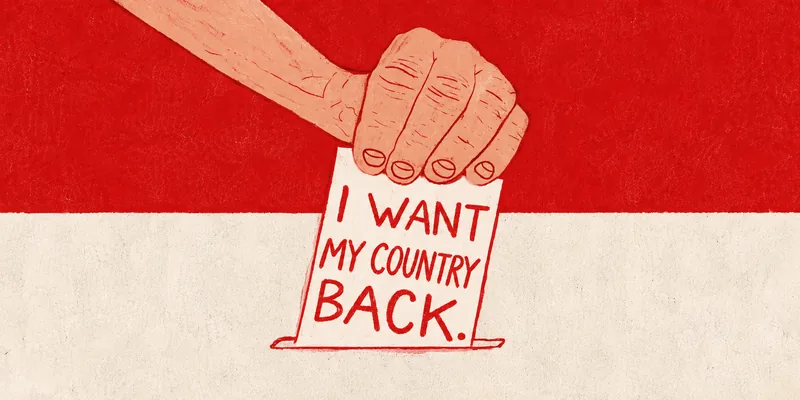
There is a sentence that is hard to say out loud in Indonesia without people hearing a different sentence. I love my country, but not the government. The moment it leaves your mouth, someone translates it for you: you are unpatriotic, you are ungrateful, you are one of those people who complain about everything and build nothing. They do this because the government has spent a long time teaching us that the two are the same, that to question the people in charge is to betray the country behind them. It took me years to see the trick in that equation. The opposite is closer to the truth. Confusing the country with its government is the real betrayal.
Let me start with the part I am sure about, because it matters. I love Indonesia. Not in the abstract, the way you love a word on a map. I love the specific, ordinary, unglamorous Indonesia that has nothing to do with palace corridors. I love the soup stall that opens before dawn, where the old man remembers that I do not want coriander and does not make me ask twice. I love the motorcycle-taxi driver who waited at the gate after my ride ended, because he saw me struggling with a heavy bag and decided, without being asked, that I was his problem for the next ten minutes. I love how a stranger on a crowded train will hold your bag while you fix your sandal, how the whole carriage becomes briefly, wordlessly responsible for you. That is the country I love. It has never once let me down.
The country is not a slogan
The country I love is made of people, not portraits. It is the food-stall owner who apologizes for the prices as if the markup were her idea, when we both know who really sets them. It is the teacher who keeps showing up to a school that is falling down, the nurse working a double shift for a wage that would make you weep, the fisherman who goes out before the sun because the sea does not wait for anyone's policy. None of these people are in the cabinet. None of them got a seat as a reward for loyalty. They are the country. The government is only ever renting it.
When I say I love my country, I mean I love the thing that exists whether the government does its job or not. The country is the language, the food, the way we laugh at our own chaos because crying about it would take all day. It is the neighbor who brings you food when someone dies, the driver who refuses your fare on Eid because it is a day for giving. The government is none of these things. The government is a set of people with power over all of it, and loving the country gives them no automatic claim on my loyalty. Patriotism is not a blank check written to whoever happens to be sitting in the capital.
The food is more expensive and nobody is sorry
Let me be concrete, because love that stays abstract is just a mood. The other week I bought the same plate of vegetables I have bought for months, the one with the peanut sauce, and it cost three thousand rupiah more. Three thousand. Not a fortune. But the reason it went up is the story: a grand free-meal program buys food in such volume that the market quietly learns to charge more, and the people the program was supposed to help end up paying for it. The program is announced as generosity. The bill arrives at the food stall. That is the gap between the country and the government: one feeds you, the other tells you it is feeding you while the price rises.
It would be one thing if the program only made the vegetables more expensive. It is another when the meals themselves start hurting people. The children who fell sick after eating the free school meals did not fall sick because the program was too ambitious. They fell sick because somewhere between the announcement and the plate, safety stopped being the point. The food arrived late, or cold, or cooked in kitchens that were never inspected, by suppliers chosen for reasons that had nothing to do with nutrition. When the response to a sick child is to have the teachers taste the meal first, you are not fixing the food. You are simply adding more people to the list of who gets hurt before anyone listens.
And watch what happens to the program when it fails. It is not scaled back to something that can actually be done well. It is not paused while the kitchens are fixed. It is defended, expanded, and wrapped in a larger flag, because admitting that it is broken would mean admitting that the people who promised it were wrong. The program has become more important than the children it was supposed to feed. A government that cannot say we made a mistake is a government that will keep repeating it, louder, until the mistake becomes the policy.
The cuts and the corruption
A budget is a confession written in numbers. The money for the things that keep ordinary life running, the clinics, the flood drains, the salaries of the teachers and nurses who do the actual work, gets cut, delayed, or quietly redirected, while the projects that photograph well always seem to find their funding. When the people in charge have to choose between a road that gets them reelected and a drain that saves a neighborhood, the drain loses, the neighborhood floods, and next year the same road gets built again. I do not want to believe it is all one scheme. I just notice that the cuts never seem to land on the people who made them.
The corruption is not a headline anymore. It is weather. It is the permit that costs more than it should because three people need to be paid along the way. It is the tender that a company with no history somehow wins, the project announced for twice what it should cost, the difference disappearing into accounts no one will ever audit. The country is not short of money. It is short of people willing to account for it. We are told the corruption is being fought. Then we are told the fight must happen quietly, out of sight, and year after year the same pattern wins, wearing a different face and the same smile.
We blame heaven for what we did to the earth
The disasters arrive on a schedule, and each time we are told they are an act of God. The landslide buries a village, the flood takes the houses by the river, the drought burns the harvest, and the people in charge fold their hands and call it a test, a warning, a reminder of who is really in control. God may well be in it somewhere. But so is the logging, the mining, the drainage that was never dug, the permits that let people build where the water always wanted to go. God did not cut down the hillside. God did not pave the flood plain and sell it. We did that, and then we blamed the sky, because blaming the sky is free and fixing the ground costs money.
That is the real crime of calling a preventable disaster an act of God. It is not piety. It is paperwork. It absolves everyone with a permit to approve and a budget to sign, and it asks the victims to be patient instead of asking the officials to be accountable. A flood is not a mystery. It is a receipt, and someone should have to answer for it. But as long as we file it under heaven, no one on earth has to. You cannot argue with a test, only endure it, and enduring it with prayer is easier than demanding that the drainage get built.
The piety that faces the palace
There is a kind of religious leader in my country who has figured out the system perfectly. He speaks about God with great authority, and somehow every sermon ends in the same place, praising the powerful. The official caught with his hand in the treasury is called a good man who is being framed. The corrupt are forgiven before they are investigated, if they are on the right side. The more loudly a man praises the president, the more saintly he becomes. I do not understand how devotion to God became devotion to the people who claim to represent Him, especially when the loudest claimants are the ones who need the endorsement most.
The truly religious people I know do not behave this way. They are quiet about it. They feed the hungry, visit the sick, and treat the janitor with the same respect they would show a minister. They do not need the government to be holy. They just need it to be honest, and they would never mistake a man in a palace for a man of God. But the ones who speak the loudest are the ones on television, and the ones on television have made peace with power. They are not worshiping God. They are worshiping the men who stand closest to the throne and call the rest of us unpatriotic for noticing.
The rich get richer while the poor are told to wait
Which brings me to the part that stings the most. The people who run this country are doing fine. The people who defend them are doing fine. The rich are getting richer, and they are getting richer in a country where the poor are told to wait. The gap does not close. It widens, politely, with a slogan on it. The ones who eat well are the ones who decide what everyone else eats, and they have never once had to explain why. The people I love are not asking to be rich. They are asking not to be punished for being poor, and somehow that has become too much to ask. That is not a country failing by accident. That is a country being managed in a particular direction, and the direction is not toward the people I love.
Poverty is everywhere if you look, but it is not the poverty of old movies. It is the mother who skips a meal so her children can eat. It is the family that cannot afford the hospital and prays instead. It is the man who has worked for thirty years and still has nothing to show for it but tired hands. The country is rich in the things that get photographed and poor in the things that keep people alive. And the gap is not an accident of fate. It is a choice, made every budget season, and the poor are the ones paying for it.
The graduates who did everything right
And then there are the young people, the ones who did exactly what they were told. They studied, they passed, they carried their degrees home like tickets to a future that was promised. And the future was already sold. The graduate in my neighborhood has a degree in accounting and drives a motorcycle taxi, and he is one of the lucky ones because at least he works. His friends are still at home, sending out applications that vanish into inboxes, watching the jobs they trained for go to people who know someone. They did everything right, and the country that taught them to believe in the reward is the same country that cancelled it. The government calls them lazy or unskilled. It never calls them betrayed, though that is the truer word.
I think that is what breaks my heart about the graduates. They believed us. They believed the promise that if you study hard and follow the rules, the country will take care of you. They are not angry yet, most of them, just tired and quietly confused, wondering what they did wrong. And the honest answer is that they did nothing wrong. They were sold a promise by a system that never intended to keep it, and now they are old enough to notice. A country that cannot feed its young people hope does not have a youth problem. It has a leadership problem, and it keeps blaming the young for the failure of the old to keep their word.
I am not listing all of this to win an argument. I am listing it because each item on its own is easy to wave away, and together they stop being accidents. The mother who skips a meal, the graduate who cannot find work, the sick child, the flooded village: these are not separate failures. They are the same failure repeating, and the pattern is the point. The government does not fail occasionally. It fails structurally, and it asks us to call the structure love.
The defenders confuse loyalty with identity
The hardest part is not the government. It is the people who defend it no matter what, because they have tied their identity to it. You see it in the comments, in the group chats, in the uncle at the family gathering who treats any criticism like a personal attack. Every mistake is defended. Every failure is spun into a win. Every scandal is met with but the other side is worse, as if that were the standard we set for the people who run our lives. I do not understand this, and I have stopped pretending I do. Blind loyalty is not love of country. It is fear wearing a flag.
I think what bothers me most is the arithmetic of it. The defender gains nothing from the defense. The official they protect will not remember them, will not feed their family, will not be there when trouble reaches their street. Yet they argue with strangers for hours, for free, in defense of people who would not recognize them on the street. It is unpaid work for a room that forgets you. Meanwhile the country, the real one, the one made of neighbors and stall owners and tired teachers, gets no one rushing to defend it. Everyone wants to defend the government. Almost no one defends the country from the government.
The flag is not a shield
Here is the trick the powerful have perfected. They wrap themselves in the flag, and then any criticism of them becomes, by their telling, an insult to the flag. Question the policy and you are questioning the nation. Point out the corruption and you are unpatriotic. It is a beautiful mechanism, really. It turns the most precious thing we share, our love of this place, into armor for the people who mismanage it. The flag should protect the people. Instead they use it to protect themselves from the people.
They ask us to love the country and prove it by never criticizing the people who run it. But criticism is how love stays honest.
I have stopped accepting that trade. I love Indonesia enough to want it to do better, and wanting it to do better means being angry when it does not. That is not the opposite of patriotism. It is the only version of patriotism that costs anything. The people who built this country did not build it so that we would nod politely while it is taken apart. They built it so that we would have something worth fighting for, and fighting for something sometimes means refusing to pretend it is fine when it is not. A country that cannot hear criticism is a country that has stopped learning, and a country that has stopped learning is already losing.
I will keep loving it anyway
Some days the exhaustion wins and I want to stop caring. I look at the same corruption wearing a new face, the same promises dressed as progress, the same defenders repeating the same lines, and I wonder why I bother. But then I walk outside and the country answers me. The street food is still good. The neighbor still waves. The stranger still helps. The country does not need me to believe in its government to be worth loving. It only needs me to keep showing up for the parts that are real.
So I will say it plainly, and I will not let anyone translate it into something uglier. I love my country. I love its mornings and its food and its people, the ones who hold it together while the ones in charge take credit for it. And I do not love the government, not as a mood and not as a position, but as a record of what it has actually done. Loving the country does not require me to defend its failures. Loving it is exactly why I refuse to.
The country will outlast every government that ever rents it. It outlasted the ones before and it will outlast this one, and the people I love will still be here, cooking the soup, driving the motorcycle taxi, teaching the children, holding the country together the way they always have. The government is a chapter. The country is the whole book, and I am not going to stop reading it just because I do not like this chapter. I will keep loving Indonesia, loudly and without apology. I just will not let anyone mistake that love for a promise to protect the people who keep failing it.
Thanks for reading.
Save this story for later, or pass it to someone who might need the perspective.
Did this make you think?

Follows good stories wherever they hide, from construction sites to coffee counters. No specialty means nothing is off the table.