We moved in last month, and like most moving days it ended in a room full of cardboard and two very tired people. What surprised me was not the mess. It was how quickly the apartment stopped feeling new, and how little of that had to do with the walls. The paint was barely dry and the light fixtures still looked like they belonged to whoever lived here before, yet somewhere around the third evening the place quietly stopped being a project and became somewhere we lived.
Part of it, I think, is that moving forces decisions that living usually lets you postpone. Every box has to land somewhere, and where it lands says something honest about what you actually want close at hand. Ours made a fairly blunt statement. The kettle came out first. The plant went onto the windowsill before the cutlery found its drawer. The books were freed before the sofa cushions, which tells you everything about how we planned to spend our first evenings.
The longer we unpacked, the more convinced I became that every household runs its own version of this test, and the order is a kind of fingerprint. The couple who unpacks the kitchen first is cooking their way toward feeling settled. The one who hangs pictures first needs walls that answer back. Almost everyone leaves the bathroom for last, not because it is unimportant but because it is the least fun room in the house, and we are all, on moving day, children choosing the best chores.
Then there are the boxes you circle instead of opening. We had two of those, and they were the honest part of the whole operation. The things you leave packed the longest tell you what you can live without, and sometimes you discover you have been carrying something you never needed. In our case it was a shelf of winter coats in a city that had forgotten what snow felt like. They stayed sealed for three weeks before we admitted they belonged to a past climate, and donated them to someone who actually had winters.
The unpacking is a conversation
Where things go is a conversation about what matters, held without words, usually on the first exhausted evening. But the conversation does not end when the last box opens. The half-unpacked box becomes furniture. The pile labeled temporary has a way of becoming permanent, and a stack you plan to deal with on the weekend quietly turns into the stack you will move again in a few years without ever having opened it.
I have decided a shelf of boxes is not failure. It is a place where decisions are still sleeping. A home is not finished when the boxes are gone. It is finished when you have stopped apologizing for the corner where you are still deciding, and that may never happen, and that is fine.
A place is claimed in small acts
Grand gestures are not what makes a place yours. No one ever felt at home because the shelves were perfectly styled. Territory is claimed by repetition, by the tiny acts you stop noticing after a week: the chair each of us naturally takes at the table, the side of the bed that is never discussed, the mug your hand finds in the dark, the drawer that is yours even though both of you could use it. In our first fortnight we had exactly one argument, and it was about where the mugs should live. Looking back, that argument was not a conflict. It was a ceremony. We were not fighting about crockery. We were practicing the small act of deciding together, and the first time you disagree about a shelf is the first time the place truly belongs to both of you.
None of these claims would photograph well. The lamp we leave on in the hall, the radio that lives on the kitchen counter, the windowsill that has become the plant's permanent residence before the curtain rods even arrived: a visitor would call the apartment unfinished, and they would be right, and it would not matter. The finish comes later. The claims came first, and claims are what ownership actually is.
A home is claimed by repetition, by the tiny acts you stop noticing after a week.
A home is a routine, not a state
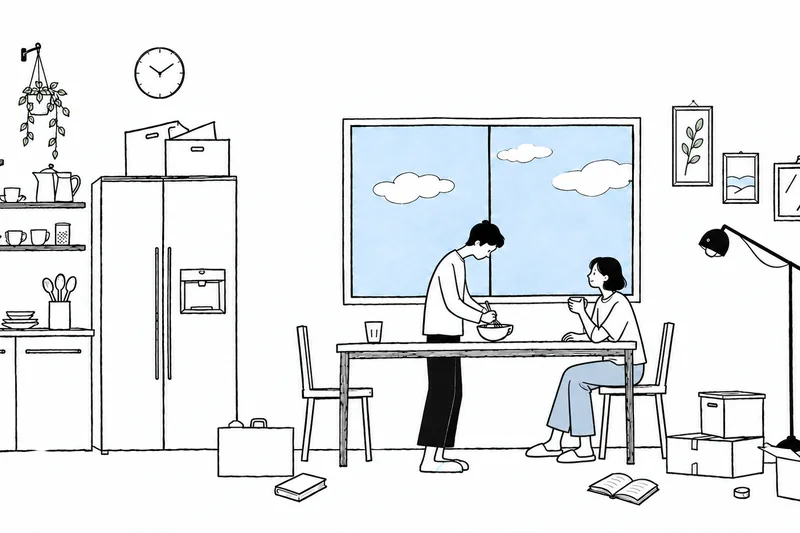
I used to believe a place becomes a home only when it is finished: shelves full, pictures straight, keys on a hook by the door. Watching our own week one unfold, I am not sure completion has much to do with it. The apartment felt like ours long before it looked like ours. It happened on the evening we cooked dinner at the table instead of unpacking around it. The meal was ordinary. The feeling was not.
That first evening did more for the place than any box ever could. It turned the rooms from a project into a rhythm: this is where we eat, this is where we sit, this is how we spend the part of the day that belongs to us. The rhythm arrived before the decoration, and I think it always does. Home is not the state of the shelves. It is the routine that keeps them full.
You can feel the moment a place crosses over. It is when the first guest rings the bell and you suddenly care about the corner with the sleeping decisions. It is the first time you come back from somewhere and catch yourself calling the new place home without thinking. It is the evening you reach for your mug without looking, because your hand already knows where the cupboard is. A place stops being new when your body stops consulting you about it.
The same habit that makes a home can also keep it unfinished, and I try to hold both truths at once. Routine is how a place becomes yours. But routine is also how the boxes stay packed. The corner of sleeping decisions only stops being a corner if, every so often, you open one box on purpose.
Beginnings look unfinished on purpose
An apartment is only the most visible place this pattern shows up. A new job looks like two weeks of reading documents and asking where the coffee is. A new city looks like wrong buses and empty weekends. A first draft looks like a mess, because it is one, and that is the point. Every beginning is a room full of cardboard.
The mistake is to wait until a beginning looks respectable before you actually start it. Wait for the right job title, the right apartment, the right version of yourself, and you spend the useful weeks somewhere else, building someone else's rhythm or none at all. The people who settle fastest are rarely the ones who planned the most. They are the ones who started the ordinary parts early: the first meal, the first introduction, the first ugly draft sent anyway.
The fix is not perfection. It is the ordinary, done on purpose. Cook even though the counter is full of boxes. Introduce yourself even though you will forget everyone's name. Take the wrong bus and learn the city from the detour. Small ordinary actions claim space faster than grand plans, because they tell the place, and tell you, that you have already arrived. The grand plans are not cancelled. They are simply scheduled for later, which is what every beginning secretly is: a promise that the finish is coming, made livable by the fact that you started the ordinary part.
The apartment is nearly finished now, and I like it. But when I think about the day it became home, I do not picture the finished rooms. I picture the evening when dinner won over cardboard, and two people sat down at a table still surrounded by boxes and understood, without saying it, that they had already arrived. We were not settling in. We were starting something, and starting, it turns out, is mostly choosing to live in the unfinished.
The coats went to a friend of a friend who actually has winters, and I try not to make that small donation sound profound, because it was not. It was just the conversation finally answered. Every unpacked box is a question about whether something still belongs to your life, and the answer is allowed to change. That is the part nobody warns you about on moving day: you are not just deciding where things go. You are deciding, in small installments, who you are now. The boxes ask it kindly, one cardboard corner at a time, and the apartment, once you let it, answers back.
Thanks for reading.
Save this story for later, or pass it to someone who might need the perspective.
Did this make you think?

Gets lost on purpose and reports back. Abraham writes about ordinary days, good sandwiches, and whatever he found on the way.