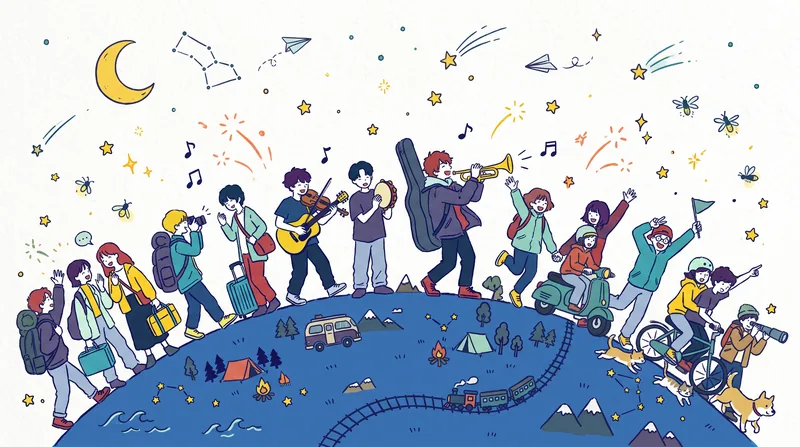
A friend sent me a drawing last week and I have been thinking about it ever since. It shows a small blue planet against a cream coloured sky, and on the curve of that planet about thirteen people are walking together. Somebody is carrying a suitcase. Somebody is playing a guitar. Somebody is steering a bicycle with a passenger on the back, and the passenger is holding a green flag and pointing at something the rest of us cannot see. Down on the surface there are paper tents and a campfire, a tiny steam train, a dog, a cat, and a crescent moon hanging over the whole thing like a lamp left on for somebody who is still out.
I looked at it for longer than a drawing usually earns. Then I noticed the thing that had been bothering me without asking permission, which is that nobody in the picture is escaping. There is no prison in the background. No boss is chasing them and no deadline is on fire behind them. They are simply walking, in the same direction, at a speed nobody has negotiated. That is the entire picture. A group of people on a Tuesday.
The postcard version of free
I have a bad habit of reading freedom as an event. The word arrives in my head already dressed up: a resignation letter, a one way ticket, a van with a mattress in the back, a Monday morning with nothing written on it. Something dramatic, something you announce. I have planned that version of my life maybe nine times, usually in the shower, and I have never once gone through with it, and I suspect I never will.
The postcard version has a problem built into it. It treats freedom as a thing you buy with a big enough sacrifice, and sacrifices are expensive, so the whole idea stays theoretical. You need the savings, the courage, the right year, the right amount of nothing left to lose. You need to be the kind of person who can leave. So you keep the picture on the fridge and get on with the week, and freedom becomes one more item on a list of things you are behind on, filed somewhere between learning a language and going to the gym.
That is a terrible trade and I have been making it for years. I gave freedom a price tag it never asked for, and then I used the price as an excuse.
What the drawing actually shows
Look again at what those thirteen people are doing. Almost nothing. One of them is taking a photograph of nothing in particular. One is playing a tambourine, which is the least efficient instrument ever invented and possibly the happiest. Two of them are sharing a bicycle, which means one person is doing all the work while the other holds a flag. Not one of them is doing anything impressive. They are all just out, together, in no hurry, on the same evening.
The detail I keep returning to is the tents. Somebody has already stopped for the night. The fire is lit and the tent is up, which means the journey is not a race to a destination. The people down on the globe have exactly the same freedom as the people walking on top of it. Stopping is allowed. That is a strange thing to notice in a drawing, and it quietly undid something in me.
Nobody in the picture is running. They are walking, together, in a direction they picked.
The small permissions
So I have been running an experiment, and it is embarrassingly small. Instead of planning the dramatic exit, I have started collecting ordinary permissions. Leaving the office when the work is done instead of when the guilt runs out. Walking the long way home because the light is good. Saying no to a meeting that exists mainly to prove the meeting happened. Taking one hour on a Saturday that has no purpose I can report to anybody afterwards.
None of these are content. None of them would make a good photograph and none of them would survive being described at a dinner party. That is exactly why they work. A permission costs almost nothing, which means I can spend it today instead of saving it for a version of myself who has more money and better weather. The grand gesture has been on layaway for a decade. The small permission I can afford right now, and it turns out that paying in small amounts is the only way I have ever actually bought anything.
There is a catch and I would rather say it out loud. Small permissions are easy to give away. A phone call on a Tuesday, an hour that belongs to me, a walk with no destination: all of it is the first thing to go when the week gets loud. The dramatic plan is protected by its own drama. Nobody asks you to cancel a sabbatical. Everybody asks you to cancel the walk.
It is not a solo thing
Here is the other thing the drawing got right, and it took me a while to see it. Everyone in it is with somebody. Somebody carries the bags while somebody else plays. Somebody steers while somebody else holds the flag. There is a person at the back looking through a telescope, and a dog, and a cat, and a train full of people, and not one figure is standing alone in a field having a profound realisation.
I used to imagine freedom as a private thing. My own schedule, my own rules, my own apartment with my own silence. I still want some of that, honestly. But the version of free I actually remember from the past few years is never solo. It is a long dinner where nobody checks the time. It is the friend who drives you home the long way because the conversation is not finished. It is a group chat that goes quiet for two weeks and then picks up exactly where it stopped.
Freedom, it turns out, is mostly something you do with other people, which is inconvenient, because other people have schedules. That is why the small permissions matter so much more than the big ones. A large plan demands a large commitment from everyone involved. An hour on a Saturday is something you can genuinely give somebody.
The bill for being free
There is a cost and I do not want to pretend otherwise. Every ordinary permission I take is a small disappointment delivered to somebody. Leaving on time means a message sits unanswered until tomorrow. Skipping the meeting means being slightly less visible in a room where visibility is currency. Walking the long way home means dinner is later and somebody is waiting. Freedom in its small version is not free. It is just cheap enough to pay for.
The trick, if there is one, is that the bill arrives immediately and the reward arrives slowly. That is the opposite of how work pays. At work the effort comes first and the payoff shows up in a message within the hour. With an ordinary free hour you pay the discomfort now and the feeling turns up weeks later, in a way you cannot point at. It is a terrible deal on paper and the only deal that has ever changed how a month felt.
So I have stopped waiting for the version of my life with nothing on the calendar. That week is not coming and I have known it for a while. What is coming is next Tuesday, and it has one free hour in it if I defend the hour, and it has a friend in it if I text first, and it has a long way home in it if the light is good.
An ordinary ending
The drawing is still in my camera roll. I keep opening it at odd moments, in queues and waiting rooms, and it keeps saying the same unremarkable thing. There is a moon, a globe, a campfire, and thirteen people who are not going anywhere in particular and are not sorry about it. Nobody in it has quit anything. Nobody has a plan worth presenting to a room.
That is the version of free I am trying to learn. Not the exit, not the announcement, not the year off that I will keep planning forever. Just the ordinary kind. An evening with no purpose, the company that makes it worth having, and the small permission I keep having to give myself, again and again, on an average day, when nothing dramatic is happening and nobody is watching.
The picture is not a plan. It is a reminder, and it only works if I do something small before the week takes it back. So before I close this, I am going to text somebody about a Saturday. That is the whole essay. That is the whole thing.
Thanks for reading.
Save this story for later, or pass it to someone who might need the perspective.
Did this make you think?
Gets lost on purpose and reports back. Abraham writes about ordinary days, good sandwiches, and whatever he found on the way.