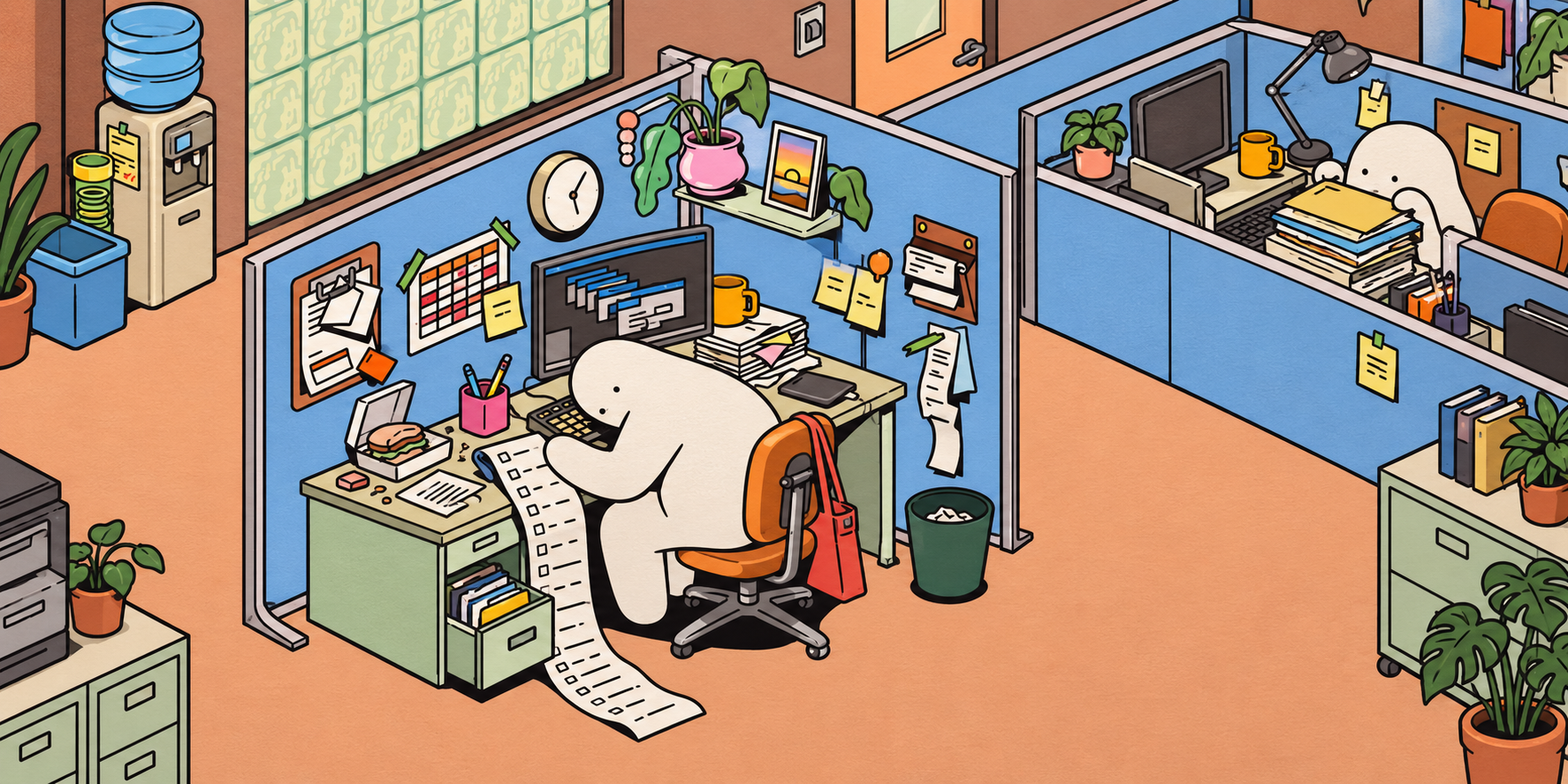
A colleague once told me that the office is the only place where people say goodbye like they mean it and then cannot remember your name by the weekend. I laughed because it was funny and because I knew exactly what he meant. He was not complaining about small talk. He was warning me about the quiet mistake of confusing the people who share your calendar with the people who share your life. The line between the two is real, and most of us only notice it after we have already stepped over it.
Let me be clear about what I am not saying. I am not saying your coworkers are bad people. Most of them are good people, and a few of them will become real friends over the years, the slow kind of friendship that survives a job change and a city change and a decade of silence in between. But the office is not built to make friends. It is built to make things, and the friendships that happen there are a side effect, not the product. When the schedule shifts or the project dies or the team scatters, the friendships that were really just convenience tend to go quiet first.
I learned this early and in the mildest possible way. At my first job I shared a desk pod with a woman I genuinely liked, the kind of person you stay late with because the conversation is better than the work. We said we would stay in touch when she moved on. We meant it, and we also did not, and it took me a while to understand that this was not a betrayal on either side. The friendship was real while it lasted. The mistake would have been calling it permanent. People rotate through your life at work the way seasons rotate through a year, and the trick is to enjoy each one without pretending it is the whole climate.
Warmth is not a contract
The confusion usually starts with kindness. You help a teammate hit a deadline. You let a colleague vent about their manager. You remember the name of their kid and ask about the soccer game. Somewhere in there the relationship starts to feel deeper than it is, because it feels like friendship, and friendship comes with duties. Friends answer late-night calls. Friends keep confidences. Friends take sides. But what actually happened is smaller and better. You were warm at work, and warmth at work is a professional skill, not a promise.
The cruelest version of this confusion is the workplace that calls itself a family. That word sounds warm until you notice what it is used for. Families do not fire you. Families do not track your hours or rank you against your peers or move you to another city because the numbers changed. When an employer says we are family, they are usually asking for the loyalty of a family while offering the terms of a contract. The math never works in your favor, and it was never meant to.
Loyalty, demanded
Here is the part nobody says out loud. The same confusion runs in the other direction, and it is not always the company doing the asking. A manager who reminds you that they are not just your boss but your friend is usually warming you up for a request that would sound unreasonable coming from a boss alone. The message lands at a quarter past six on a Friday. The ask is wrapped in we are in this together and I would not ask anyone else. The word friend is doing heavy lifting, and if you accept the title, you hand over the right to say no and keep your weekend intact.
You can also be the problem on the other side without meaning to. The colleague who treats you like free therapy, who unloads every private disaster into your afternoon and expects you to carry it, is using the word friendship the same way the manager does. It is a way of taking more than the relationship can hold. Real friends respect what you are willing to carry. People who just want a listener rarely notice that you are carrying anything at all.
Everyone is replaceable, including you
Here is the sentence nobody puts on the wall. Everyone at work is replaceable, including you, including the person who trained you, including the founder who named the company after his dog. The posting goes up, the seat fills, and within a few months nobody quite remembers who sat there before. I am not telling you this to be grim about it. I am telling you because it is the most freeing thing I know about work, and I wish someone had said it to me plainly instead of letting me discover it by watching a brilliant colleague walk out and the machine keep running.
Think about what that means. If the office can survive without you, then it cannot hold your identity hostage. You are not betraying the place by guarding your evenings. You are not failing the team by doing the job you were hired to do instead of the one that grows quietly in the margins until it becomes your whole life. You stay because you choose to stay, and a choice you make freely is the only kind that counts. The teams that understand this do not fall apart. They get better, because the people in them are there by choice, and chosen loyalty is the only loyalty that ever held up under real pressure.
Boundaries are not coldness
So the fix is not to go guarded or fake. The fix is to know what the relationship actually is and to treat it as that. You can laugh with someone at lunch every single day and still keep your weekend. You can respect a teammate deeply and still not tell them about the fight you had at home. You can be the person everyone likes working with and still close the laptop at six and mean it. Professional affection is not a lesser version of friendship. It is a different thing that deserves its own honest shape.
The test I use is simple. What happens to this conversation if one of us changes jobs? If the honest answer is that it disappears, then it was never friendship. It was proximity, and there is nothing wrong with proximity. It is how most adults meet their friends in the first place. The mistake is treating proximity as proof of something deeper, and then feeling betrayed when the depth was never promised.
The good news is that the alternative is not a colder office. You still owe the people around you a great deal, and knowing the difference is what makes it possible to pay. You owe them competence. You owe them honesty about a problem while there is still time to fix it. You owe them courtesy, follow-through, and a warning before you drop something on their desk. None of that requires you to be available at midnight. A clear no is more respectful than a resentful yes, and the coworker who says I cannot take that on this week without pretending to be delighted about it is the one everyone actually trusts.
Small talk is not emptiness
Somewhere along the way, shallow became a dirty word, and I want to defend it for a moment. A room full of people who need to share eight hours and a budget cannot all be best friends, and it does not need them to be. Small talk is the oil that keeps that room running. Asking about the weekend is not a failed attempt at intimacy. It is a successful act of courtesy, the same way holding a door or saying thank you is. You are not required to bare your soul to prove you are genuine. A real good morning, said like you mean it, is already a true thing.
I used to feel guilty about the shallowness of work friendships, the way they live on weather and deadlines and which lunch place is fastest. Then I started thinking of them as neighbors. You do not tell your neighbor about your marriage troubles or your childhood or your fear of the dark. You talk about the fence, the rain, whose cat keeps wandering over, and somehow that is enough to make a whole block feel like a neighborhood. Depth is not the only honest register of care. There is a care that lives in small reliable things, coffee made, deadlines met, a seat saved at the table, and it is not a cheap version of friendship. It is a different currency, and it spends very well.
The office is a public room
One more thing I learned the slow way. Not every thought belongs in the building. Early on I treated my team like a diary, telling them the whole weather of my private life because it felt honest and because they listened so kindly. I was confusing two different things. Listening at work is polite. Listening at work is not the same as being invited into everything.
The workplace is a public room, and anything you say there has a half-life longer than your time in the room. People change jobs. Teams restructure. Someone you trusted as a friend in March is reading your old confession as context in October, because context is what the office does with information. This is not an argument for dishonesty. It is an argument for knowing the difference between a shared office and a private one, and for telling people only as much of your life as you would be comfortable explaining to a stranger who once sat next to you.
Real friends stay when nothing is at stake
I have had a handful of real friendships start at work, and every single one crossed the border on purpose. We did not drift into them by sharing a standup. We chose each other outside the building, when there was nothing to gain and no reason to be kind except that we wanted to be. That is the difference, and it is the only one that matters. Your coworkers are the people you make things with. Your friends are the people you make things with and then keep, long after the making is done.
The strongest of those friendships began with a bus. We were the only two who took the 6:40, and for months we talked about nothing at all, the driver, the rain, whether the new stop was really faster. Then one evening the bus was late and she mentioned, in passing, that her father had died the week before and that she had told almost no one at work. Not because the people there were unkind. Because she wanted one corner of her life that the office did not manage. After that we talked about real things, slowly and on purpose, and by the time we no longer worked at the same company, the friendship no longer needed the company to exist. It had moved out of the building on its own, the way real ones do.
So go ahead and like your coworkers, warmly and without apology. Eat lunch with them. Help them hit the deadline. Laugh at the same jokes and remember the names of their kids. And when the afternoon ends, go home to your own life without guilt, because the separation is not a failure of warmth. It is the boundary that lets the warmth be genuine. The people you work with do not have to be your family, your diary, or your everything. They just have to be good company for the hours you share, and if a few of them turn out to be more, let that happen on its own, in its own time, outside the building where it can actually grow.
Thanks for reading.
Save this story for later, or pass it to someone who might need the perspective.
Did this make you think?

Follows good stories wherever they hide, from construction sites to coffee counters. No specialty means nothing is off the table.