This morning I woke up tired, before anything had happened. Not the deep tired of a short night; the flat tired of a week that has gone on too long, the kind that lives behind the eyes and answers every good plan with a quieter version of we can start tomorrow. I lay there while the alarm did its work and thought about the sentence I keep meeting everywhere lately, in my own head and in the things other people say: we have to keep going. It is a strange sentence. Nobody can tell you exactly where going leads. And yet everyone who has ever finished anything has, at some point, repeated it to themselves like a prayer they were not sure they believed.
The dramatic version of giving up gets all the attention: the slammed door, the resignation letter, the moment someone announces they are done. In my life, almost nothing quits loudly. Projects do not die in arguments; they die in afternoons. They die when the excitement of the beginning has worn off and the reward of the end is still out of sight, and the only thing left is the work itself, which has stopped feeling like an adventure and started feeling like an errand. That is where most things end: not with a decision, but with a Tuesday.
The long middle
Every worthwhile thing I have ever finished spent time in a place with no name. The beginning has energy, the end has witnesses, but the middle has neither, and it is longer than both. I think the middle is where character is actually made, and I also think it is where most of us quietly leave. We are raised on stories that cut from the decision to the result, and the screen goes dark exactly when things get unglamorous. Real life does not have a montage. Real life has a paragraph you rewrite for the sixth time, a half-finished thing on the table that asks every morning whether it is still worth it, a goal that has not moved this week and will probably not move next week.
From the inside, the middle looks like failure. The progress is too small to see from where you are standing, and the doubt is loud enough to fill the room. I have learned to distrust my own view from there, because the middle has bad eyesight. When I am in it, I cannot tell the difference between something that is stalled and something that is dead. The only honest test I have found is not how the work feels but whether I still want the thing the work is for. Feeling can change by the hour. Wanting, when it is real, survives the bad mornings.
I am learning to look around me when I am in the middle, because everyone around me is mid-climb too, and their middles look like nothing from the outside. The barista at five is in the middle of a rush she cannot see the end of. The driver in the lane beside me is carrying a week he will not mention. The neighbour whose work looks finished from here is usually mid-way through the next thing, and I would never guess it. We only ever see the outside of the middle of someone else, which is why other people always look more finished than we feel. Nobody looks unfinished from a distance, and nobody is finished up close. The middle is not a private defect; it is the normal condition of everyone who is making anything.
Motivation is weather
We talk about motivation as if it were a fuel tank, something you run out of and must refill before you can drive again. Wait until you feel ready, the culture whispers, and the waiting becomes a lifestyle. The people I respect most do not seem to run on this at all. The barista who opens the shop at five in the morning is not doing it because she feels inspired; she is doing it because the shop opens at five, and because people are counting on coffee. The friend who trained for a marathon through the rainy weeks did not decide each morning to feel like running. She decided once, months ago, and then let the decision carry the mornings that offered no help.
That is the trick I keep forgetting: motivation is weather, and commitment is a schedule. Weather changes; you do not cancel your life because of it. On the days I feel nothing, I try to do the smallest possible version of the thing, the version that does not need to be believed in: open the file, write the date, wash the mug, send the message. Small steps do not need enthusiasm. They only need to be taken, and taken steps have a way of quietly leading to the next ones. I also keep one rule that has saved me more times than I can count: never make a decision on a bad morning. Bad mornings are for small steps and nothing else. The temptation to quit, examined at noon, almost always turns out to be the temptation to sleep in, dressed as a decision.
Motivation is weather. Commitment is a schedule. Nobody cancels their life because of rain.
Keep going is a plural verb
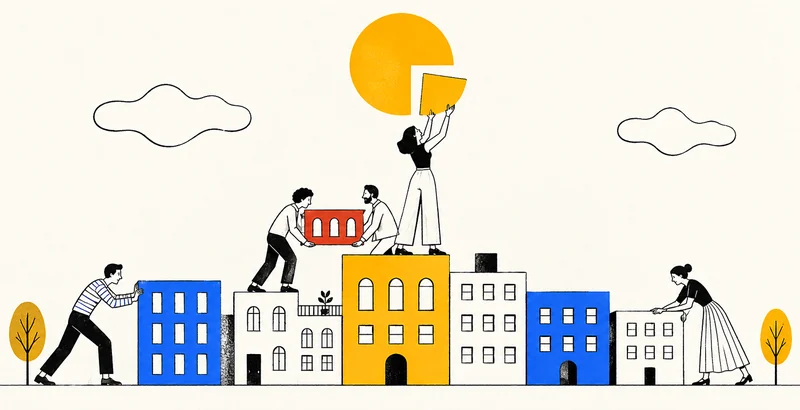
Here is the part I understand least and believe most: nobody keeps going forever for their own sake. Underneath every stubborn person I have known, there is always a we. Someone kept going so that they could. A parent who left for work before light, so that a child could stay asleep a little longer. A teacher who answered the same question for the hundredth time, because the hundredth student deserved the same patience as the first. A colleague who carried the project through their own bad week, so that the good week of everyone else was still possible. We like to imagine persistence as a solitary virtue, one person against the wall. In my experience it is more like a relay that nobody announced: you are only able to keep going because, somewhere behind you, someone already did.
And then comes the turn I do not always want to face: you are now that someone. Right now, somewhere, a person is watching whether it is possible. A child, a coworker, a stranger who reads what you make. If you stop, you do not only stop your own thing; you quietly cancel an example. You tell the person behind you that the wall wins. I do not think we carry that weight on purpose, most of us; we just do, the way a lighthouse does not decide to be seen. And it is not only pressure. It is company. Nothing crosses the long middle alone; the relay is real, and the people beside you are half the reason you are still moving. We have to keep going is not a demand I make on myself. It is a description of what we are already doing for each other.
Rest is part of the climb
An essay with this title has to be careful, because the sentence can be used as a whip. The people who need it least are the ones who never stop. The sentence they need is not we have to keep going; it is what you have done is enough for today. I have met those people, and I have been one of them: the ones who keep going until keeping going stops being a choice and becomes a cage they carry around. Rest is not the enemy of persistence. It is how persistence is paid for. The runner rests between intervals, the writer walks away from the page, and the body repairs itself only in the hours nobody is watching. A long climb is not finished faster by refusing to stand up; it is finished by standing up and then sitting down, on purpose, in the right order.
The difference between resting and giving up is not visible in the moment. Both look the same from the outside: the same stillness, the same day off, the same closed laptop. The difference is the return. Rest comes back to the thing by its own choice, a little fuller each time. Giving up does not come back, and it stops calling itself a rest and starts calling itself the truth. I try to keep the two apart by keeping the return in sight: when I stop, I name out loud what I am coming back to and when. What makes rest different from giving up is not the rest. It is that you come back.
Rest is not the opposite of keeping going. It is how keeping going is paid for.
The wrong kind of persistence
I need to say the other half, because keep going can curdle into its opposite. Blind persistence is not a virtue; it is a trance. The world is full of people who kept going straight into the thing they should have left, because stopping felt like losing, because they had come too far, because everyone would ask why. Sunk cost is not a reason; it is an anchor. The sentence we have to keep going does not mean we have to keep doing this. It means we have to keep going toward the thing we chose, and sometimes the bravest step in that direction is a change of direction.
The mountaineer who turns back in the storm has not quit the mountain; she has quit the mistake of pretending the mountain is not also a weather system. The difference I try to watch for is between hard and wrong. Hard is the paragraph that will not come, the muscle that will not grow this month, the distance that still has most of itself left. Hard asks for patience, and patience answers. Wrong is the goal that stopped being yours, the work that costs more than it could ever return, the voice that tells you to keep going but will not say what for. Wrong asks for courage, and courage sometimes means leaving. I want to be the kind of person who can tell the difference, and who does not let one bad afternoon convince her that hard is wrong, or one good one convince her that wrong is hard.
Real persistence, I am learning, is not stubbornness about the path. It is stubbornness about the destination, and flexibility about everything else. You can keep going and change jobs, change plans, change your mind about how. What you do not change is the wanting. The people who finish are rarely the ones who never turned around; they are the ones who kept the compass and surrendered the route.
Persistence is not stubbornness about the path. It is stubbornness about the destination.
Keep a what for
There is one more test I run when the climb goes dark, and it is the quietest one. I ask the sentence to give me its reason. The voice that says keep going but cannot say what for is not a compass; it is momentum. Momentum will carry you in any direction, including the wrong one, for a very long time. Direction needs a destination: something as small as a child asleep, a craft you are still learning, a promise you made to yourself or to someone else. I keep a short list of the what for, three things, no more, and I read it on the mornings when the sentence alone is not enough. It is not a vision board; it is a memory aid, because the reasons I started are the first things the middle makes me forget.
The list changes slowly, and that is the point. The child stays. The craft deepens. The promise gets kept, or it gets quietly retired, and retiring a promise is allowed if it was never yours to keep. What I am going toward is not a fixed point I will arrive at and be done with. It is a direction I keep choosing, the way a tree keeps choosing the light, a little each day, without ever seeing the whole of what it is becoming. The what for does not have to be enormous. It only has to be true, and it only has to be mine. Nobody keeps climbing for a blank horizon; we keep climbing for the things the horizon is hiding, and those things are usually small, and usually waiting for us to come back to them.
Small steps still count as steps
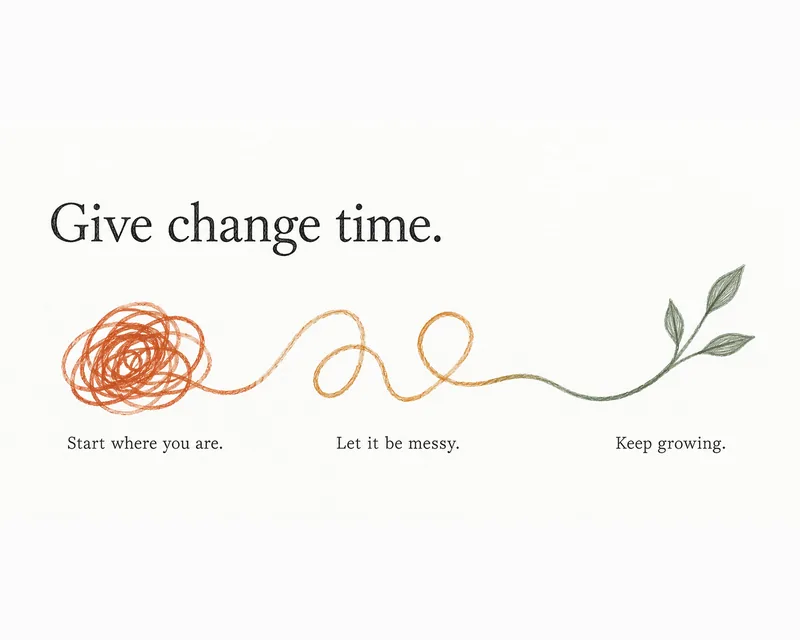
I have started to distrust grand renewals. The dramatic promise, the clean Monday, the vow made at midnight: they burn bright and go out fast, because they ask the future for energy it has not earned. The steps that actually carry you are smaller and less impressive: the walk you take even though you do not feel like it, the draft you write even though it will be rewritten, the morning you show up even though nothing will be finished by evening. None of it photographs well. All of it compounds. A step does not stop being a step because it is small; it stops being a step when it is not taken.
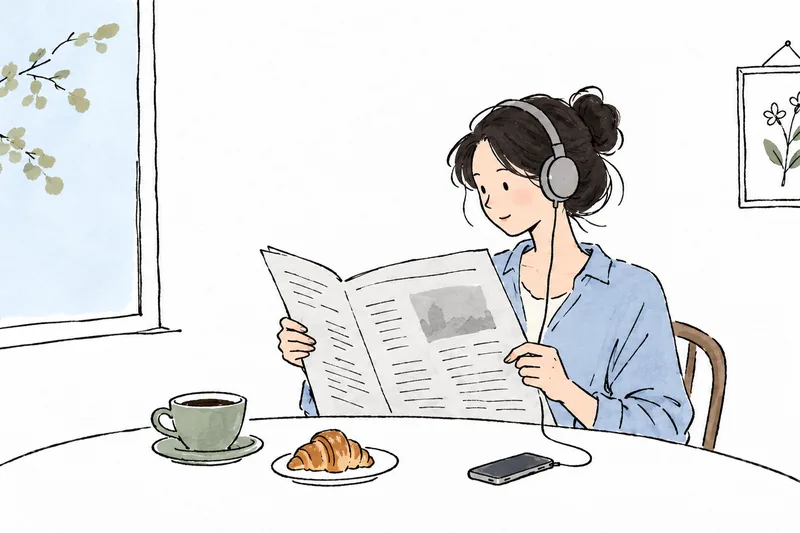
Some days I do not believe any of this. Some days the sentence sounds like noise. But I have noticed that I do not need to believe it to act on it, the way I do not need to believe in the sunrise to set the alarm. Faith and practice are different muscles, and practice goes first. On the mornings when the week sits heavy on my chest, I get up anyway, and I make the coffee, and I sit at the table with the newspaper and the headphones, and I begin. Not because I have decided the day will be good. Because the day will happen whether I decide or not, and because the person I am trying to become is not built by my good days. She is built by the ordinary ones, the ones where keeping going was the whole job.
I think about the people on the same route as me, the ones who leave before light and come back after it, the ones who keep opening, keep teaching, keep carrying, keep making. None of us knows, most days, whether any of it will add up. We do it anyway, and the doing is the answer. We have to keep going. Not because the top is guaranteed, and not because the road is fair. Because somebody behind us is still watching to see whether it is possible, and because the only way to show them is to take the next step where they can see it.
Thanks for reading.
Save this story for later, or pass it to someone who might need the perspective.
Did this make you think?
Some weeks an essay, some weeks a field report, some weeks a list nobody asked for. Aiko writes whatever refuses to leave her alone.