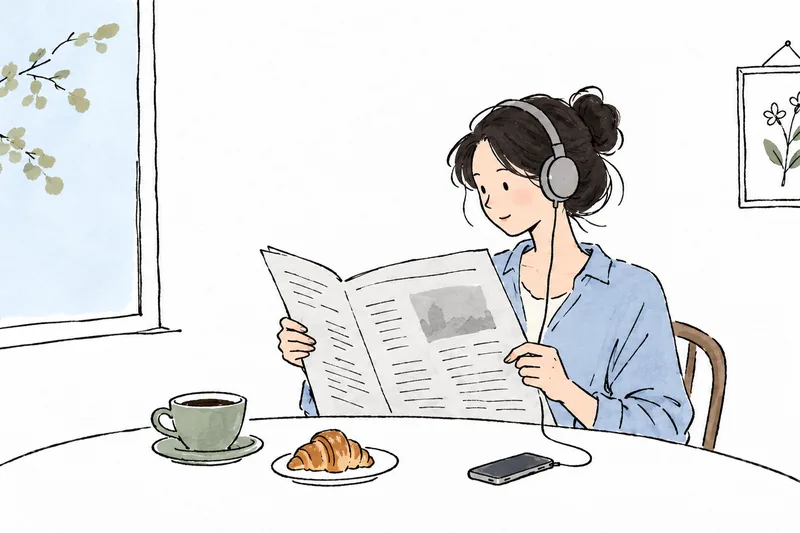
Some mornings I think the slow way: coffee, headphones, the newspaper spread across the table. The world arrives in rectangles of other people's opinions, and I get to choose which ones to let in. It is a useful habit and a strange one, because it keeps raising a question I never quite finish answering: why should I care what any of these people think? I am not asking sarcastically. I want the actual answer, because pretending not to care is its own kind of performance.
The honest answer is that none of us is a reliable narrator of our own life. Other people catch what we miss: the outfit that does not fit the room, the habit that quietly hurts us, the tone that landed badly. A trusted opinion is early weather. It tells you about conditions before they reach you. To never care is to fly without instruments, and the people who claim they are immune to other people's views are usually just deaf to the useful ones along with the noisy ones.
Caring is how we calibrate
Caring, in the useful sense, is calibration. Writers need readers before publication day. Builders need someone to walk through the door before they add the second floor. Anyone who makes anything learns that a good opinion, given early, is the cheapest repair they will ever get. I have rewritten whole paragraphs because one careful reader said the middle was weak, and the piece was better for it. That is not weakness. That is craftsmanship.
Calibration also works backwards, and this is the part nobody teaches. You can learn what you actually value by noticing whose opinions you cannot stand to lose. The reviewer whose silence stings is not a random voice; they are someone whose judgment you have quietly filed under needed. The comment that ruins your afternoon usually ruins it because it comes from a person you respect. Naming that is half the work. The rest of the crowd can only annoy you. They cannot wound you, and the difference between annoyance and a wound tells you exactly who your real audience is.
Performing is different
But there is a second thing people call caring, and it deserves a different name. Performing is when you change direction for someone who has no stake in your life and no expertise in what you do. You can tell the difference by what you are reshaping. Caring lets a good opinion change what you make. Performing lets an average opinion change who you are.
Performing is expensive. The crowd never agrees with itself, so trying to satisfy it means running in every direction at once and ending up tired and unrecognizable. People who perform for everyone end up with an audience that does not remember them and a life that does not feel like theirs. You are doing unpaid work for a room that forgets you the moment you leave.
I can date the exact moment I learned this. I had written an essay and a confident acquaintance, who had never written one, told me an ending should be hopeful or nobody would share it. I rewrote the ending into something blander and safer. The essay did worse, the acquaintance never read the second version, and I was left with a piece that pleased no one, least of all me. Nothing was lost except the original ending, and the only person who had asked for it to change had not even bothered to check whether I changed it. That is the signature of performing: you reshape yourself for an audience that was never going to watch the finished product anyway.
The crowd has no memory
Platforms did not invent other people's opinions. They only changed the volume. A single loud comment can outshout fifty quiet ones, and criticism travels faster than the work it describes, because anger is cheaper to spread than understanding. One stranger's confident sentence about your character can outlive the careful sentence you actually wrote. It helps to remember the arithmetic: the crowd is not fifty people who thought about it. It is one person who typed fast, and a few hundred who pressed a button.
The useful part of the crowd is that it forgets. The person whose take defined your Tuesday has moved on by Wednesday, and by next month they will not recognize the thing they were so sure about. But you stay, and you stay with the edits you made for them, the sentences you deleted to please them, the direction you abandoned to satisfy them. Performing is not just exhausting. It is permanent work for a temporary audience. The crowd leaves the theater and the only person still on stage is you, holding changes nobody asked for twice.
Keep a shortlist
The practical version of this is simple: most opinions are weather, and a few are maps. The question is never whether to care. It is whose opinion gets to matter, and I keep the list very short. People who have done the thing I am trying to do get a vote. People who tell me the truth because they want the outcome, not my comfort, get a vote. Everyone else gets politeness, and politeness is not the same as permission.
A shortlist of three or four honest voices beats a stadium every time. The trick is to choose them before you need them, because in the middle of doubt you will listen to whoever is loudest, and the loudest are rarely the wisest. Doubt is not the moment for recruiting critics. It is the moment your shortlist earns its keep.
Building the list is deliberate. Everyone on it should pass three tests: they have done the thing I am trying to do; they want the outcome more than they want to be right; and they disagree with me sometimes. A list that always agrees is a mirror, not a map, and mirrors only confirm what you already believe. I also give my people permission to be harsh by asking specific questions, because a good opinion is an answer to a question you actually asked. Ask do you think this works and you invite politeness. Ask where does the middle lose you and you get a map.
The sting is not a verdict
None of this stops it from hurting when someone disapproves, and it helps to know why. We are wired to care about belonging because belonging used to mean survival. A raised eyebrow still registers as a small threat, even when the eyebrow belongs to someone whose life you would not trade for yours. The sting is information about our need for acceptance, not proof that the critic is right. You can notice it and choose not to obey it.
I have one rule for the sting: I am not allowed to answer in the same hour. The reply I would send while it still hurts is always worse than the situation deserves, and the person who wounded me will not remember they said anything at all. So I write the reply, put it in a drawer, and read it the next morning. Most of the time it looks silly. Sometimes it looks true. Either way, a day has passed, and the sting has been given the only thing it cannot survive: time without a response to feed on. The sting is like weather. The forecast is information. It does not get to decide whether I fly.
So the answer to the question is yes, I have to care, but only a little, and only about very few people. Enough to keep me honest, never enough to keep me quiet. Everything worthwhile I have made got better because someone honest told me the truth, and got worse every time I asked a crowd what to do. The headphones go back on. The coffee is still warm. The world keeps talking, and that is fine, because listening is a choice, and I am the one who gets to make it.
Thanks for reading.
Save this story for later, or pass it to someone who might need the perspective.
Did this make you think?

Some weeks an essay, some weeks a field report, some weeks a list nobody asked for. Aiko writes whatever refuses to leave her alone.